

Automotive Human Machine Interface Market Forecast to Register 10.3% CAGR, Reaching US$ 59.4 Billion by 2033
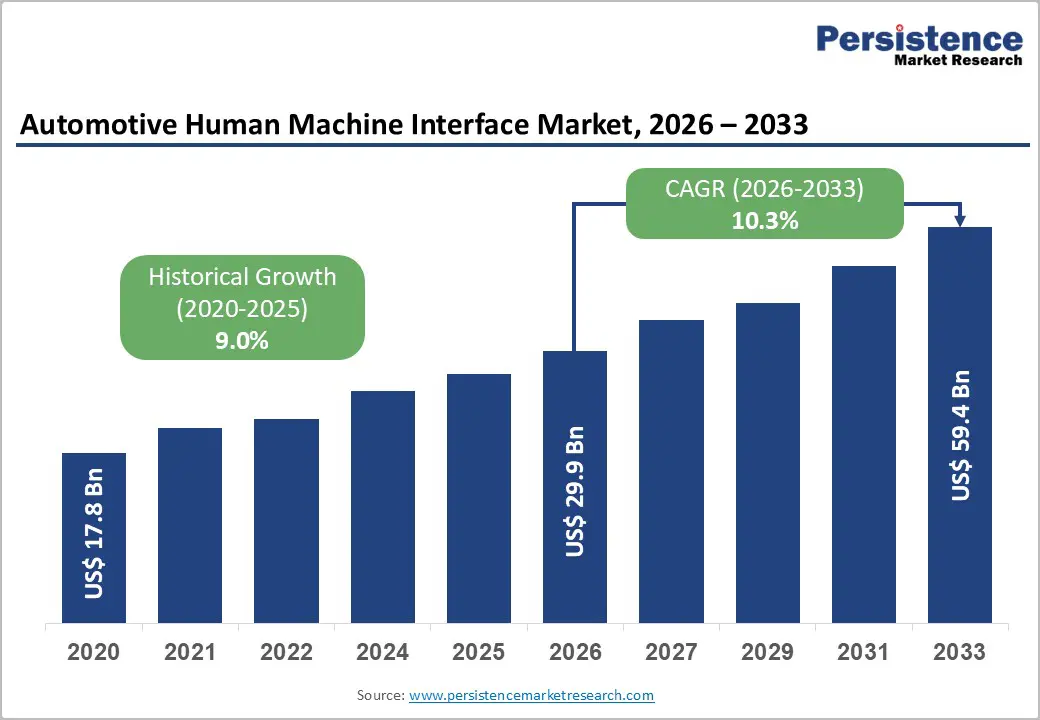
Automotive Human Machine Interface (HMI) Market Size, Share, and Growth Forecast 2026 - 2033
Automotive HMI market poised for rapid growth with advanced interfaces, AI integration, and rising demand for connected and intuitive vehicles.
BRENTFORD, LONDON, UNITED KINGDOM, March 10, 2026 /EINPresswire.com/ -- The global automotive human machine interface (HMI) market is undergoing a transformative phase driven by the rapid integration of digital technologies into modern vehicles. Human Machine Interface systems, which facilitate seamless interaction between drivers and vehicles, are becoming increasingly sophisticated with the adoption of touchscreens, gesture controls, voice recognition, and augmented reality displays. These advancements are enhancing the overall driving experience while improving safety, convenience, and vehicle performance monitoring.
The global automotive human machine interface (HMI) market size is projected to reach US$ 29.9 billion in 2026 and is expected to grow significantly to US$ 59.4 billion by 2033, exhibiting a CAGR of 10.3% between 2026 and 2033. This remarkable growth is indicative of the rising demand for intuitive vehicle control systems that enhance driver engagement and safety. The market is witnessing increased penetration of advanced HMI technologies across passenger cars, commercial vehicles, and luxury segments, positioning it as a critical component of the automotive electronics ecosystem.
Among the leading segments, touchscreen-based HMI systems continue to dominate due to their versatility and ease of use. Gesture-based and voice-controlled interfaces are rapidly gaining traction as automakers aim to minimize driver distraction and enhance user experience. Geographically, North America leads the market, driven by high adoption of advanced infotainment systems, stringent safety regulations, and technological innovation by major automotive OEMs. Europe and Asia Pacific are also witnessing strong growth, fueled by increasing vehicle production, EV adoption, and a preference for connected and semi-autonomous vehicles.
Get Your FREE Sample Report Instantly Click Now: https://www.persistencemarketresearch.com/request-customization/35413
The key players studied in the report include:
• Bosch Inc.
• Denso Corporation
• Continental AG
• Alpine Electronics Inc.
• Panasonic Corporation
• Visteon Corporation
• Nuance Communications Inc.
• Clarion Co. Ltd.
• Harman
• Samsung Electronics Co. Ltd
• Other Key Players
Key Highlights from the Report
➤ The global automotive HMI market is valued at US$ 29.9 billion in 2026, expected to reach US$ 59.4 billion by 2033, growing at a CAGR of 10.3%.
➤ Touchscreen interfaces continue to dominate the product segment, offering intuitive user interaction and display flexibility.
➤ Gesture recognition and voice-controlled HMIs are emerging rapidly due to enhanced safety and user convenience.
➤ North America remains the largest regional market, followed by Europe and Asia Pacific.
➤ Rising integration of HMI systems in electric and autonomous vehicles is fueling adoption across segments.
➤ Growing consumer preference for connected and infotainment-rich vehicles is creating high demand for advanced HMI solutions.
Market Segmentation
By Operation Type
• Voice Control
• Central Display
• Instrument Cluster
• HUD (Heads-Up Display)
• Others
By Application Type
• Infotainment
• Navigation
• Driver Assistance
• Climate Control
• Vehicle Diagnostics
• Connectivity Services
By Vehicle Type
• Passenger Vehicles
• Commercial Vehicles
By Region
• North America
• Europe
• East Asia
• South Asia and Oceania
• Latin America
• Middle East and Africa
Customize This Report for Your Exact Requirements: https://www.persistencemarketresearch.com/request-customization/35413
Regional Insights
North America is at the forefront of the automotive HMI market due to strong technological infrastructure, high adoption of connected vehicles, and the presence of major automotive OEMs investing in advanced HMI solutions. The region benefits from stringent safety regulations and consumer preference for infotainment-rich vehicles, which drives the adoption of next-generation HMI technologies.
In Europe, market growth is supported by the emphasis on autonomous driving and electric vehicle integration, alongside government initiatives for vehicle safety and emission reduction. Asia Pacific, particularly China, Japan, and South Korea, is emerging as a high-growth region due to rapid automotive production, urbanization, and increasing consumer demand for smart vehicle technologies.
Market Drivers
The key drivers fueling the automotive HMI market include the rising adoption of electric and autonomous vehicles, which necessitate advanced user interfaces for monitoring and controlling complex systems. Integration of digital dashboards, infotainment, and navigation systems is becoming a differentiating factor for automotive manufacturers. Consumer demand for connected vehicles that provide seamless integration with smartphones and smart devices also drives market growth. The focus on safety and reduction of driver distraction through voice and gesture controls further boosts HMI adoption.
Another significant driver is technological advancement in display technologies, including OLED and touchscreen innovations. These enable automakers to provide visually appealing and highly functional interfaces, enhancing user experience. Increasing investment by major automotive OEMs in R&D to develop AI-enabled HMI systems further supports market expansion, ensuring long-term growth.
Market Opportunities
The automotive HMI market presents vast opportunities through the rising adoption of electric and autonomous vehicles, which require sophisticated interfaces for control, monitoring, and infotainment. Innovations in AR and VR-based dashboards offer potential for premium user experiences, attracting luxury vehicle consumers. Integration with AI and IoT technologies also enables predictive analytics, enhancing safety and personalization in vehicles.
Emerging markets in Asia Pacific and Latin America present growth potential due to increasing automotive production, rising disposable income, and urbanization. Additionally, collaborations between automotive manufacturers and technology providers to develop smart, connected, and AI-driven HMI systems provide avenues for strategic expansion. Continuous investment in research and development ensures that future vehicles are equipped with next-generation HMI solutions capable of meeting evolving consumer expectations.
Ready to Dive Deep? Buy Full Report Today: https://www.persistencemarketresearch.com/checkout/35413
Recent developments include:
• March 2025 – Bosch launched an AI-powered HMI system for next-generation electric vehicles, enhancing gesture and voice recognition.
• August 2024 – Continental AG introduced an integrated AR dashboard system for luxury vehicles, combining navigation and safety alerts in real time.
Future Opportunities and Growth Prospects
The automotive HMI market is poised for long-term growth as vehicle technologies advance. Increasing adoption of electric, autonomous, and connected vehicles, coupled with consumer demand for premium and intuitive interfaces, will drive market expansion. Innovations in AI, AR, and IoT will further enhance HMI capabilities, creating opportunities for automakers and technology providers to collaborate and deliver next-generation experiences. Emerging markets and rising urbanization present additional growth avenues, making the automotive HMI market a key focus area for future investments and technological advancement.
Persistence Market Research
Persistence Market Research Pvt Ltd
+1 646-878-6329
email us here
Visit us on social media:
LinkedIn
Instagram
Facebook
YouTube
X
Legal Disclaimer:
EIN Presswire provides this news content "as is" without warranty of any kind. We do not accept any responsibility or liability for the accuracy, content, images, videos, licenses, completeness, legality, or reliability of the information contained in this article. If you have any complaints or copyright issues related to this article, kindly contact the author above.
