

Weight Loss Services Market Expands at 7.9% CAGR Through 2033 – Persistence Market Research
weight loss services market
The global weight loss services market is expanding rapidly, driven by rising obesity, digital health, personalized programs, and corporate wellness initiative.
LONDON, UNITED KINGDOM, May 6, 2026 /EINPresswire.com/ -- The global weight loss services market is poised for substantial growth, with a projected valuation of US$ 45.6 billion in 2026, expected to reach US$ 77.6 billion by 2033. This represents a compound annual growth rate (CAGR) of 7.9% over the forecast period from 2026 to 2033. Market expansion is being driven by rising prevalence of overweight and obesity, coupled with growing demand for structured weight management services. Increasing awareness of clinical efficacy and safety has bolstered adoption among both individual consumers and institutional clients, creating a robust market environment.
Integration of digital platforms, telehealth services, and personalized mobile applications has transformed service delivery, enhancing adherence and operational efficiency. Urbanization, higher disposable income, and evolving lifestyles are key factors fueling demand for professional fitness, dietary, and surgical services. Expansion of healthcare infrastructure, including certified fitness centers, specialized clinics, and advanced surgical facilities, supports scalable service provision. Regulatory recognition of structured programs has facilitated broader market penetration through insurance coverage and reimbursement pathways.
Download Your Free Sample & Explore Key Insights: https://www.persistencemarketresearch.com/samples/16828
Key Industry Highlights
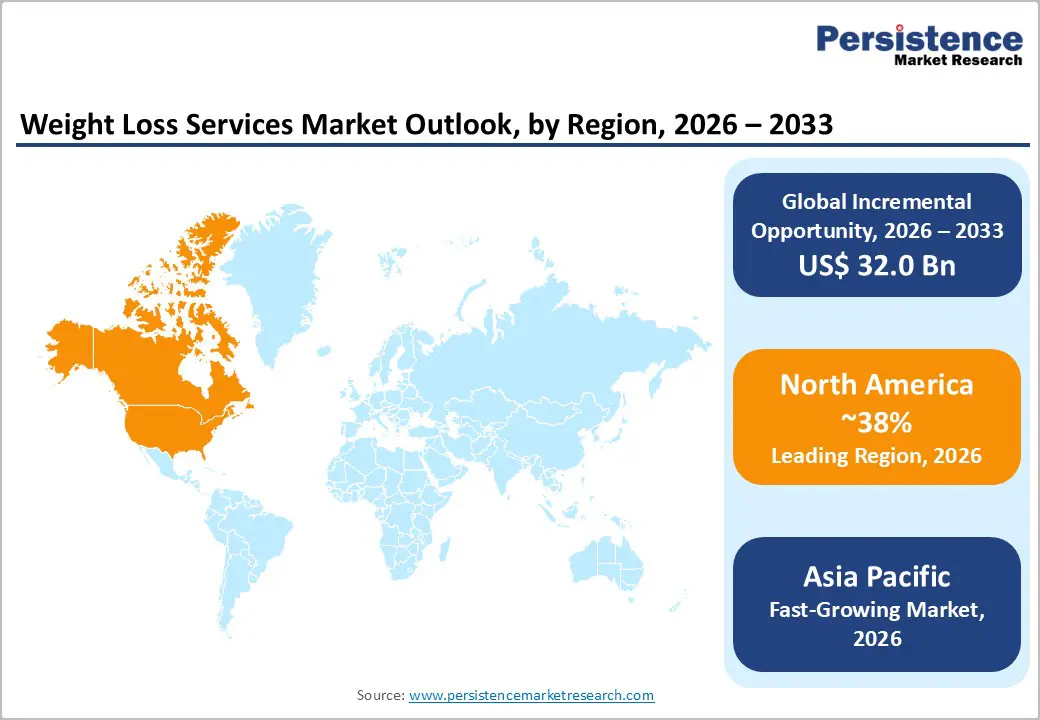
Fitness centers are projected to dominate the market in 2026, holding an estimated 35% revenue share due to their accessibility, clinical acceptance, and subscription-based models. Digital programs are anticipated to be the fastest-growing segment between 2026 and 2033, supported by mobile applications, telehealth, and AI-driven personalization. North America is expected to lead the market in 2026, accounting for approximately 38% of total revenue, driven by advanced healthcare infrastructure and digital adoption. Conversely, Asia Pacific is likely to be the fastest-growing regional market during the forecast period, supported by rapid urbanization and rising health awareness. The competitive landscape is moderately consolidated, with global chains and regional providers leveraging hybrid service models, technology integration, and corporate partnerships. In March 2026, Indian pharmaceutical companies launched low-cost generic semaglutide to enhance access to diabetes and weight-loss treatments.
Market Drivers
Rising prevalence of overweight and obesity has emerged as a significant driver for market growth. In 2022, about 43% of adults globally were overweight, while 16% were living with obesity. This trend has heightened the demand for structured weight management services to mitigate long-term health risks associated with chronic diseases. Providers are increasingly offering comprehensive programs that combine diet, exercise, clinical monitoring, and behavioral guidance to meet the growing treatment demand. Governments and insurers are investing in preventive and therapeutic services to alleviate the financial burden of obesity-related illnesses, while public awareness campaigns encourage individual engagement with professional interventions.
Integration of Digital Health and Technological Platforms
Digital health tools, including telehealth, mobile apps, and wearable devices, are enhancing accessibility and engagement in weight management programs. Telehealth interventions facilitate remote consultations and continuous monitoring, addressing barriers faced by rural populations and individuals with mobility limitations. Mobile applications and AI-driven platforms allow real-time tracking of weight, physical activity, and dietary intake, supporting personalized interventions at scale. Evidence shows that digital solutions improve adherence, promote behavior change, and extend the reach of conventional weight loss services, aligning with public health recommendations.
Get Custom Insights Designed for Your Businecss: https://www.persistencemarketresearch.com/request-customization/16828
Operational and Regulatory Challenges
High operational costs, including investment in certified fitness centers, specialized clinics, and advanced surgical facilities, remain a key challenge for market participants. Recruiting skilled professionals and maintaining equipment-intensive systems further contributes to elevated expenses. Regulatory frameworks governing weight loss services are often fragmented, creating hurdles for market entry and program standardization. Limited insurance coverage in several regions shifts financial responsibility to end users, impacting adoption rates. Clinical acceptance is cautious due to variability in efficacy evidence across interventions, necessitating investment in structured studies and outcome tracking to establish credibility.
Innovative and Personalized Solutions
Rising clinical evidence and technology adoption have enabled personalized dietary and fitness programs tailored to individual health profiles. Wearable devices, mobile tracking, and clinician oversight enhance engagement and measurable outcomes. Corporate wellness initiatives are increasingly collaborating with providers to integrate structured programs into workplaces, promoting preventive care and improving employee health outcomes.
Regional and Competitive Insights
North America remains the leading market due to robust infrastructure, widespread adoption of fitness centers, and integration of digital platforms. Europe exhibits mature, steady growth, driven by preventive healthcare adoption and technology-enabled programs. Asia Pacific is the fastest-growing region, with digital health interventions and corporate wellness programs fueling expansion. The market is moderately consolidated, with major players including Weight Watchers, Jenny Craig, Slimming World, Nutrisystem, LA Fitness, and Orangetheory Fitness leveraging brand recognition, digital integration, and hybrid service models to maintain competitive advantage.
Market Segmentation
By Function
Fitness Centers
Slimming Centers
Consultation Services
Digital Programs
Surgical Services
By Payment Model
Out-of-Pocket Payment
Government Programs
Private Insurance Coverage
By End-User
Individual Consumers
Corporate Programs
Healthcare Institutions
By Region
North America
Europe
East Asia
South Asia & Oceania
Latin America
Middle East & Africa
Checkout Now & Download Complete Market Report: https://www.persistencemarketresearch.com/checkout/16828
Key Industry Developments
In January 2026, Medicover launched an obesity clinic in Navi Mumbai offering personalized weight management solutions. Novo Nordisk introduced Wegovy in Hong Kong in November 2025, providing weekly semaglutide treatment for long-term care. In May 2025, Evernorth implemented pharmacy benefit programs capping monthly co-pays for weight-loss drugs to improve affordability and access.
The weight loss services market is witnessing transformative growth, driven by technology-enabled interventions, personalized programs, and corporate wellness initiatives, creating a dynamic and evolving landscape for providers and consumers alike.
Read Related Reports:
HPMC Capsules Market: HPMC capsules market will grow from US$2.4 Bn in 2026 to US$3.9 Bn by 2033, driven by pharma growth and rising demand for vegetarian, clean-label capsules.
Vein Illuminator Market: The global vein illuminator market will grow from US$403.2M in 2026 to US$1,807.1M by 2033, registering a strong CAGR of 23.9% during the forecast period.
Persistence Market Research
Persistence Market Research Pvt Ltd
+1 646-878-6329
email us here
Visit us on social media:
LinkedIn
Instagram
Facebook
YouTube
X
Legal Disclaimer:
EIN Presswire provides this news content "as is" without warranty of any kind. We do not accept any responsibility or liability for the accuracy, content, images, videos, licenses, completeness, legality, or reliability of the information contained in this article. If you have any complaints or copyright issues related to this article, kindly contact the author above.
